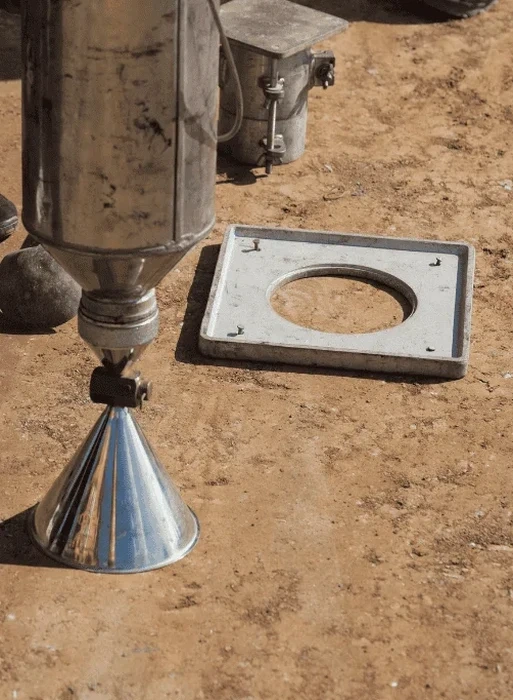
Contractors working between the East Village and the Drake neighborhood know this well: the soil changes fast in Des Moines. A site near the Des Moines River often sits on loose alluvial silts, while just a mile west you hit the stiff glacial till that defines much of the Des Moines Lobe landform. In our expertise, that difference makes field density testing non-negotiable before signing off on any compacted lift. The sand cone method gives us a direct, physical measurement of in-place density — you are not relying on indirect readings from a nuclear gauge that might need recalibration for local mineralogy. For projects where the spec calls for 95 percent standard Proctor, this test, run per ASTM D1556, tells the engineer whether the roller operator needs another pass or if the fill is ready for the next layer. We often pair this verification with Proctor testing in the lab to establish the reference curve that the field results are measured against.
The sand cone method remains the referee test — when a nuclear gauge reading is questioned, ASTM D1556 is the procedure that settles the argument.
How we work
Des Moines grew in distinct waves — the original riverfront settlement, the post-war expansion onto farmland north of University Avenue, and the recent infill pushing into areas once considered too soft to build. Each wave left a different geotechnical signature. The older downtown core sits on compacted urban fill that can hide pockets of rubble, while newer subdivisions in Ankeny or West Des Moines often strip topsoil and recompact native glacial till. The sand cone test adapts to all these scenarios because it does not depend on soil chemistry or electrical properties. The procedure is straightforward: a field technician levels a base plate, excavates a precise hole in the compacted layer, weighs every gram of excavated soil, and fills the cavity with calibrated Ottawa sand to determine the exact hole volume. The dry density is calculated on site, and the percent compaction is reported before the crew leaves the property. For fill materials with significant gravel content, the hole volume must be large enough to capture a representative sample — one reason we adjust the base plate opening and test depth based on the gradation observed. The method is sensitive to operator technique, and our team follows the step-by-step protocol in ASTM D1556 with documented field checks on the sand calibration factor at the start and end of each day. A common observation in Des Moines is that moisture content can swing several points between morning and afternoon on a hot July day; we always run a companion moisture content determination so the dry density calculation reflects the actual condition of the fill at the moment of compaction.
Local context
The mistake we keep seeing in Des Moines is relying on visual inspection or a few passes of a loaded dump truck to judge compaction on a utility trench backfill. The trench settles six months later, the pavement sags, and the street department cuts a core that shows 82 percent compaction where 95 was required. That rework costs more than a full testing program would have from day one. Poor compaction in central Iowa's silty clay fills leads to differential settlement that cracks foundations, separates driveway approaches from garage slabs, and creates trip hazards on sidewalks. The sand cone test catches these problems before the trench is paved over — a single failed test during backfill triggers immediate recompaction while the material is still workable. On structural fill under shallow footings, under-compaction can drop the bearing capacity below the design assumption, and that is a liability no geotechnical engineer wants on their seal.
Questions and answers
How much does a sand cone density test cost in Des Moines?
Field density testing with the sand cone method in the Des Moines area typically runs between US$100 and US$160 per individual test point, depending on site access, number of points needed in a single mobilization, and whether the laboratory Proctor reference curve has already been established. Projects requiring five or more test locations on the same day often benefit from a reduced per-point rate. We can carry out a written quote once we understand your site layout and fill material source.
Why choose the sand cone over a nuclear density gauge?
The sand cone method is a direct volume measurement — you excavate a small hole, weigh all the removed soil, and measure the hole volume with calibrated sand. There is no radiation source requiring licensing, no sensitivity to the iron content in Des Moines' glacial till, and no calibration drift. It is the referee method specified in ASTM D1556 when nuclear gauge results are questioned, and it works reliably across the wide range of soil textures found in central Iowa.
How many density tests does my project need?
Frequency depends on the specification governing your job. Iowa DOT standard specifications typically require one field density test per 1,500 square feet of each compacted lift for roadway subgrade, and at least one test per lift for structural backfill behind retaining walls or around utility trenches. The engineer of record may reduce or increase that frequency based on the criticality of the structure and the variability of the fill material being placed.