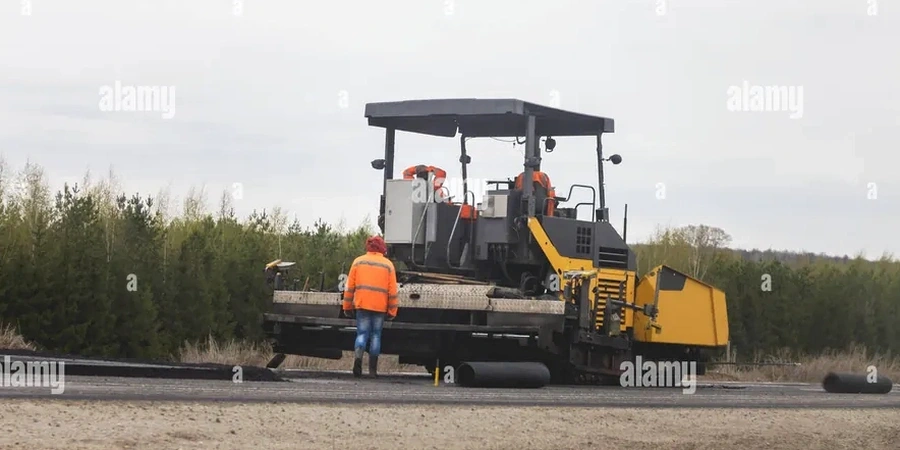
A pavement section that works perfectly in central Illinois will often fail within five years on the glacial till soils found across Des Moines. The difference is rarely the asphalt mix itself. It is what sits underneath. Our laboratory processes core samples from the same Wisconsin-age deposits that define the Des Moines Lobe, and we see consistent patterns: silty clay subgrades that lose stiffness fast once moisture content climbs above optimum. When a contractor calls us after the first winter pothole outbreak, the forensic dig almost always reveals a base course that was designed for a generic soil, not for the specific plasticity and drainage behavior of the material at that site. We approach flexible pavement design in Des Moines by building the structural section from the bottom up, starting with in-situ permeability measurements that tell us exactly how water will move through the subgrade during the January thaw, and then calibrating layer coefficients against CBR road tests run on recompacted specimens at target density.
A pavement is only as good as the subgrade it rests on. In Des Moines, that means designing for the glacial till’s moisture sensitivity, not against a generic CBR chart.
How we work
The freeze-thaw cycling that Des Moines experiences every year, typically with 30 to 40 cycles between November and March, creates a loading condition that no standard AASHTO catalog can fully capture without local calibration. When pore water trapped in the upper subgrade freezes, it expands and heaves the pavement; when it thaws, the soil temporarily loses bearing capacity and becomes susceptible to deep rutting under truck traffic. Our design sequence addresses this directly. We run moisture-conditioned
Proctor tests across a range of water contents to map the sensitivity curve of the subgrade, then pair those results with
Atterberg limits to flag any horizons where the plasticity index exceeds 20, a threshold above which we consistently observe volume change problems in Polk County projects. The structural number gets adjusted upward for these zones, and we specify a separation geotextile between the subgrade and the aggregate base to prevent fines migration into the crushed stone layer. For high-traffic corridors near the I-235 interchange, we also verify the resilient modulus with repeated-load triaxial testing so the mechanistic-empirical design inputs reflect real material response rather than textbook correlations.
Local context
The Des Moines River and its tributaries have deposited lenses of alluvial silt and organic clay that can extend five to eight feet below grade in low-lying commercial parcels near the East Village and south of the airport. These pockets are rarely identified by a standard five-foot auger boring, which is the depth many pre-purchase geotechnical investigations stop at. When a flexible pavement is built over an undetected compressible lens, the asphalt mat may look perfect for the first eighteen months, but differential settlement will open transverse cracks at the boundary between the firm till and the soft zone, and those cracks become entry points for water and freeze-thaw damage. We mitigate this by extending our subsurface exploration to a depth of at least twice the pavement’s stress influence zone, and we run consolidation tests on any cohesive sample with an organic content above three percent. If primary consolidation settlement exceeds the tolerance of the pavement surface, we either over-excavate and replace the material or specify a surcharge period with settlement monitoring before placing the final asphalt lifts.
Questions and answers
What is the typical cost for a flexible pavement design study on a commercial lot in Des Moines?
For a typical commercial lot or small industrial site in the Des Moines metro, the pavement design study including field sampling, laboratory CBR and Proctor testing, and the final thickness recommendation report generally falls between US$1,500 and US$4,750. The spread depends on the number of borings required, the depth of exploration, and whether additional testing such as resilient modulus or consolidation is needed for soft soil zones.
How deep do you need to explore the subgrade for a flexible pavement design?
We typically extend borings to a depth of at least six feet below the proposed subgrade elevation, and deeper if the preliminary data suggest compressible alluvial deposits. The rule of thumb is to investigate to a depth where the stress increment from the pavement and traffic loads drops below ten percent of the in-situ effective stress, which in Des Moines glacial till usually requires eight to ten feet of exploration.
Can you design a flexible pavement that works without a full-depth reconstruction of the existing base?
Yes, when the existing aggregate base is still structurally sound. We core through the existing asphalt, run gradation and CBR tests on the base material, and check for contamination from subgrade fines. If the base meets the specification and the subgrade stiffness is sufficient, we can design an overlay section using falling weight deflectometer data to back-calculate layer moduli and determine the required asphalt thickness for the extended design traffic.
How do you account for the freeze-thaw cycles that cause so much damage to pavements in central Iowa?
We use the Iowa DOT frost penetration index for the Des Moines region, which typically exceeds 40, to calculate the minimum cover of non-frost-susceptible material. We also condition all CBR specimens to simulate the saturated state that occurs during the spring thaw, when the subgrade is weakest. The structural number is based on that worst-case soaked strength, not on the as-compacted value, which is why our sections tend to hold up better through the March-April thaw period.