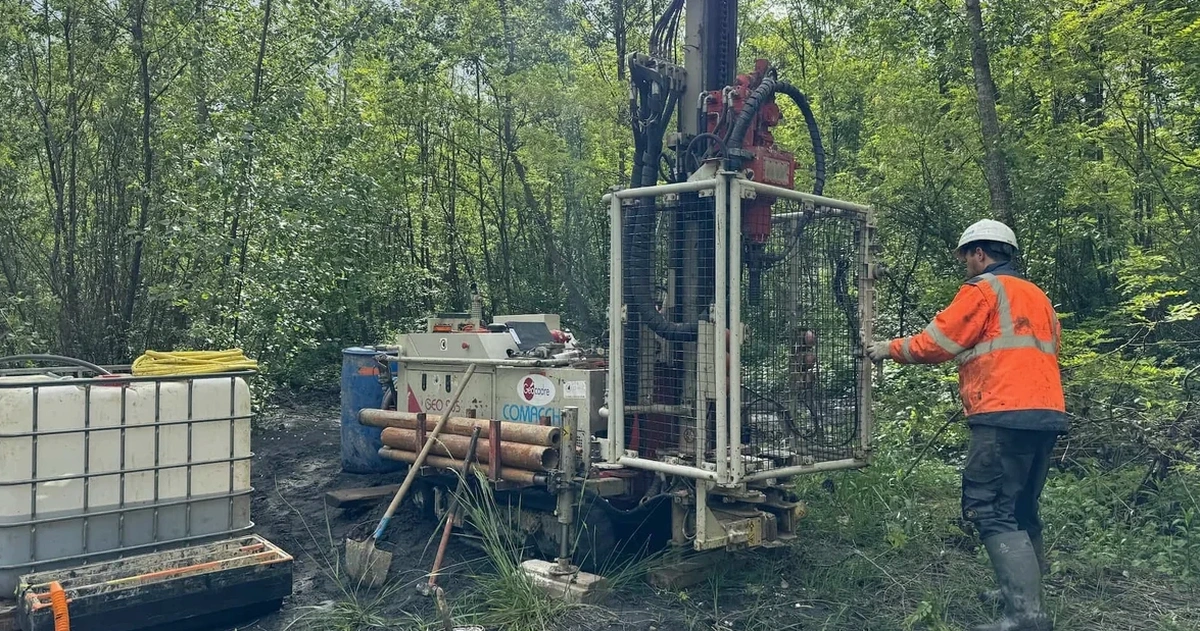
In Des Moines, we often see foundation issues that trace back to one thing: incomplete soil data. The loess-derived silts and clays across the city can look uniform at surface level, but their behavior under load changes block by block. A proper soil mechanics study defines how these materials will settle, shear, and drain over time. We run standardized index tests and strength tests to give structural engineers the numbers they need. This is not a generic report. It is a site-specific dataset built from undisturbed Shelby tube samples and bulk samples taken at foundation depth. For projects near the Des Moines River, we recommend pairing this study with a grain size distribution analysis to identify potentially collapsible silts before design starts.
Des Moines loess can lose 50% of its apparent strength when saturated. We test it dry and wet.
How we work
The surficial geology in Des Moines is dominated by Wisconsinan-age loess overlying glacial till. This sequence creates a two-layer system that controls bearing capacity and settlement. Our soil mechanics study quantifies both layers separately. We determine moisture content, Atterberg limits, unit weight, and unconfined compressive strength on undisturbed specimens.
For sites in the East Village or along the Raccoon River floodplain, we test for consolidation characteristics to estimate long-term settlement under sustained load.
Key parameters we measure include:
- Undrained shear strength from unconfined compression (ASTM D2166)
- Consolidation parameters (Cc, Cr, Pc) via incremental loading (ASTM D2435)
- Swell potential for clay layers near Beaverdale and Sherman Hill
- Soil classification per USCS (ASTM D2487)
When bedrock is shallow, as in parts of the northwest metro, we integrate data from
in-situ permeability testing to evaluate drainage requirements for basement slabs and retaining structures.
Questions and answers
What does a soil mechanics study include in Des Moines?
It includes sampling at foundation depth, index testing (moisture, Atterberg limits, grain size per ASTM D2487), strength testing (unconfined compression per ASTM D2166), and consolidation testing (ASTM D2435) when settlement is a concern. We deliver a report with design parameters: bearing capacity, friction angle, cohesion, and settlement estimates.
How much does a soil mechanics study cost for a residential lot?
How deep do you test for a foundation in Des Moines?
For shallow foundations, we sample to at least 1.5 times the footing width below the bearing elevation. In Des Moines, this usually means 10 to 15 feet. If soft alluvium is present, we go deeper to characterize the compressible layer fully.
Do you test for frost depth requirements?
Yes. Des Moines requires foundations to extend below a frost depth of 42 inches per local code. We sample through and below this depth to ensure the bearing stratum is frost-stable and has adequate strength for the design load.