← Home · Slopes & Walls

Retaining Wall Design for Des Moines Sites

Together, we solve the challenges of tomorrow.

LEARN MORE →

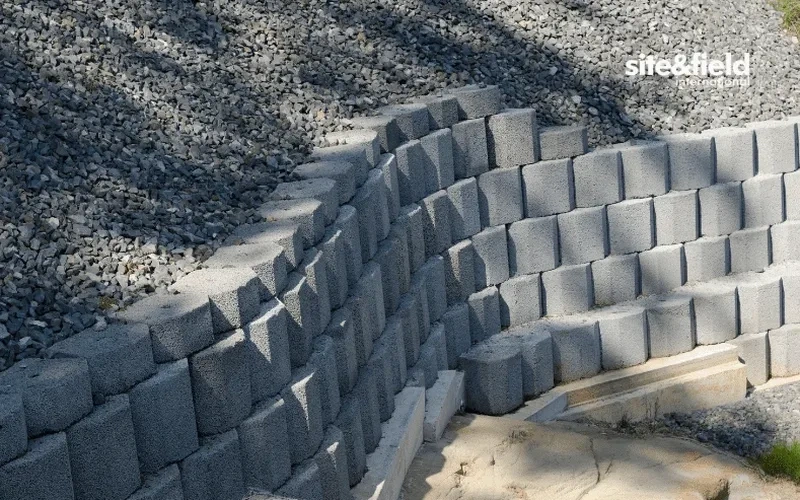
A commercial project along Ingersoll Avenue ran into a six-foot grade change between the parking level and the street right-of-way. The owner wanted a vertical wall to reclaim every square foot of usable space, but the upper four feet of the cut exposed weathered glacial till with lenses of sandy silt that sloughed within hours of exposure. We mobilized a crew that same week because the excavation was already open and a late-October rain event was forecast. The retaining wall design had to handle not just the lateral earth pressure of the native till but also construction-stage surcharge from a mobile crane set up six feet behind the wall line. In Des Moines, where winter freeze-thaw cycles reach depths of 36 to 42 inches, backfill drainage and frost protection govern long-term performance more than bearing capacity alone. Before finalizing reinforcement details, we correlated the till properties with data from a nearby SPT drilling program and confirmed the friction angle assumptions against site-specific grain-size curves.

A retaining wall in Des Moines lives or dies by its backfill drainage — freeze-thaw cycling demands a granular chimney drain and a positive outfall, no exceptions.
How we work

Soil conditions shift noticeably between the historic Sherman Hill neighborhood and the commercial strips south of Grand Avenue. Sherman Hill sits on a thin mantle of loess over pre-Illinoian till — the loess can stand near-vertical when dry but loses cohesion rapidly with moisture. South of Grand, the till is shallower and often contains discontinuous sand seams that act as perched water pathways during spring thaw. These contrasts mean a retaining wall design that works with a gravity block system on the Hill may need a cantilever reinforced-concrete stem south of Grand, simply because the lateral load profile changes when a sand lens saturates. We pull continuous soil profiles from borings and supplement them with CPT soundings where the till contains cobbles that make SPT interpretation unreliable. For walls exceeding eight feet, we also run Atterberg limits on the retained soil to confirm the plasticity index used in active-pressure calculations, since Des Moines tills can contain pockets of fat clay with PI values above 25.
Retaining Wall Design for Des Moines Sites
Technical reference image — Des Moines

Local considerations

Des Moines sits at roughly 955 feet above sea level on a dissected till plain, and the city's 2020 census count of 214,000 residents drives steady redevelopment of sloping lots that were bypassed in earlier building cycles. The biggest risk we encounter is not wall overturning — it is internal erosion of retained soil through poorly graded backfill. When clay-rich till is placed directly against a wall with only weepholes, fine particles migrate during heavy rain, voids form behind the stem, and hydrostatic pressure builds because the weepholes plug. We have opened exploratory test pits behind distressed walls downtown and found cavities the size of a basketball directly above the heel. A related hazard is global slope failure where the wall is founded near the top of a natural slope that descends toward the Raccoon or Des Moines River — the wall itself may be stable while the entire slope mass moves beneath it. Our analysis always extends the failure search beyond the wall footprint, using Spencer's method and site-specific shear strengths from consolidated-undrained triaxial tests.

Need a geotechnical assessment?

Reply within 24h.

Email: contact@geotechnicalengineering1.org

Typical values

ParameterTypical value
Design methodologyASCE 7-22 / IBC 2021 / LRFD
Wall types analyzedGravity, semi-gravity, cantilever, counterfort, anchored
Retained soil characterizationASTM D2487 classification, Atterberg limits, triaxial shear
Backfill specificationASTM D698 compaction at 95% of maximum dry density, granular free-draining
Global stabilitySpencer or Morgenstern-Price method, circular + block search
Seismic coefficientPer USGS 2018 NSHM, Site Class D or E dependent on borings
Drainage systemPerforated toe drain, filter fabric, weepholes at 10-ft spacing

Other technical services

01

Geotechnical Investigation for Wall Design

Borings and CPT soundings to define retained and foundation soil profiles, groundwater elevation, and shear strength parameters for active, at-rest, and passive earth pressure calculations.

02

Structural Wall Design and Detailing

Cantilever, gravity, and anchored wall sections designed per ACI 318 and IBC, including reinforcement schedules, joint layout, and drainage details.

03

Global and Internal Stability Analysis

Limit-equilibrium slope stability modeling with Spencer or Morgenstern-Price methods, plus internal compound stability checks for MSE walls with geogrid reinforcement.

04

Construction Observation and Instrumentation

Full-time observation during backfill placement, compaction testing per ASTM D698, and tilt monitoring on adjacent structures within the zone of influence.

Applicable standards

ASCE 7-22 Minimum Design Loads, IBC 2021 Chapter 18 Soils and Foundations, ASTM D1586-18 Standard Penetration Test, ASTM D2487-17 Unified Soil Classification, AASHTO LRFD Bridge Design Specifications Section 11

Questions and answers

How much does a retaining wall design cost in Des Moines?
When is a building permit required for a retaining wall in Des Moines?

The City of Des Moines requires a building permit for retaining walls over four feet in height measured from the bottom of the footing to the top of the wall, or for any retaining wall supporting a surcharge such as a driveway or building. Walls under four feet with no surcharge generally do not require a permit, though geotechnical evaluation is still recommended.

What wall type performs best in Des Moines glacial till?

Cantilever reinforced-concrete walls tend to perform well in the pre-Illinoian till common across Des Moines because they can accommodate moderate differential settlement and their weight provides ample sliding resistance. Gravity block walls are suitable for heights under six feet where the retained soil is granular, but they require careful leveling pad preparation on the stiff clay subgrade.

Do retaining walls in Des Moines need seismic design?

Yes — Des Moines lies in a region of moderate seismicity, and IBC 2021 requires seismic lateral earth pressure increments for walls that retain more than six feet of soil or support critical structures. We use the USGS 2018 National Seismic Hazard Model to determine the peak ground acceleration and apply a pseudo-static coefficient in the stability analysis.

Location and service area

We serve projects across Des Moines and surrounding areas.

View larger map