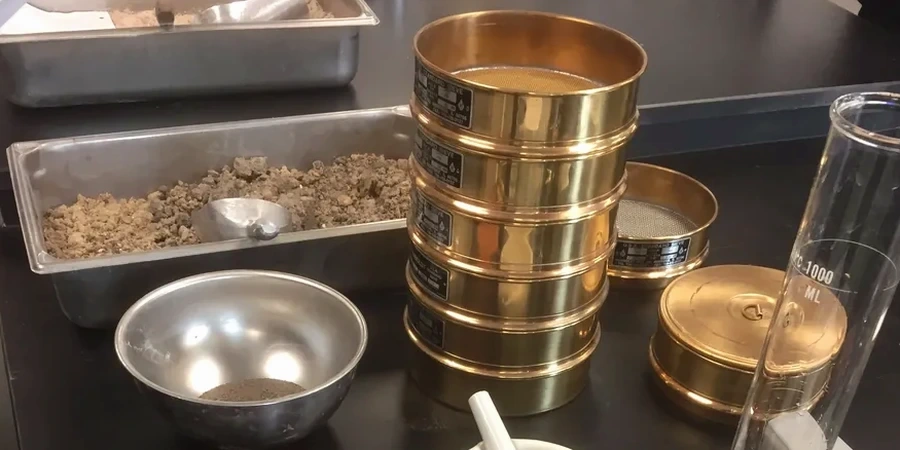
Between the loess-mantled uplands of the South Side and the alluvial terraces near the Des Moines River, the grain size distribution shifts dramatically within a few city blocks. On Grand Avenue you might hit lean clay, but two miles east in East Village the profile turns to silty sand with traces of gravel — and that difference determines whether your footing can bear on native material or needs overexcavation. Our grain size analysis runs the full stack: mechanical sieving for the coarse fraction down to 75 microns, then hydrometer sedimentation for the fines, so the gradation curve isn't just a number on a report — it's a defensible classification under ASTM D2487. For sites near the Raccoon River confluence, where floodplain deposits include interbedded organic silts, we often pair this test with Atterberg limits to nail down the plasticity before recommending a moisture-conditioning strategy.
A sieve without hydrometer misses the 15 percent fines that control frost susceptibility — and in Iowa that's the difference between a pavement that lasts and one that heaves.
How we work
In the field we keep seeing the same headache on Des Moines projects: a contractor runs a standard sieve alone, gets a clean-looking coarse fraction, and then wonders why the subgrade pumps during compaction. That missing hydrometer tail — usually 12 to 18 percent clay passing the No. 200 sieve — holds the answer. We run the full ASTM D422 procedure, starting with oven-dried mass determination, then wet-sieving over the 75-micron screen to separate sand from silt-clay, and finally a hydrometer reading series at 0.5, 1, 2, 5, 15, 30, 60, 250, and 1440 minutes. The resulting curve gives D10, D30, D60, and Cu/Cc values that feed directly into USCS classification and drainage estimates. When the project involves pavement design on arterial roads like Fleur Drive, we tie the gradation results to a
CBR test so the structural section isn't guessed from textbook tables.
Local context
Des Moines sits on a patchwork of Wisconsinan glacial till, loess, and post-glacial alluvium — the till south of downtown can carry 30 percent fines while the sand lenses in the buried valleys pass 95 percent on a No. 4 sieve. Misclassifying a silty sand as a well-graded gravel because the hydrometer step was skipped leads directly to underestimated settlement and drainage problems. The IBC, through Chapter 18, requires a defensible grain size distribution for any shallow foundation design, and a sieve-only dataset doesn't meet that bar. On sites within the Des Moines Lobe where frost depth reaches 48 inches, the percent passing the 75-micron sieve controls the frost-susceptibility classification — get it wrong and the pavement section will fail before the first rehabilitation cycle. Our lab's ISO/IEC 17025 accreditation means the hydrometer curve is defensible to the reviewing geotechnical engineer and the city building official without back-and-forth.
Questions and answers
How much does a grain size analysis cost in Des Moines?
Do I really need the hydrometer if the soil looks sandy?
Yes — visual classification is misleading. We have tested material from the West Des Moines area that looked like clean sand in the field but contained 14 percent clay by hydrometer, enough to shift it from SW to SC-SM and completely change the drainage assumption.
What sample quantity do you need from the site?
For a complete sieve and hydrometer run we need approximately 1,500 grams of oven-dried material in a sealed plastic bag. For gravelly soils with particles larger than 3 inches, a 5-gallon bucket sample lets us run the full coarse-fraction split without bias.
Can you test samples that have already been compacted?
Yes, we run grain size on compacted specimens as well — for example from a Proctor mold or a Shelby tube — but you must specify whether the material should be oven-dried and crushed gently to break cementation or tested in its in-situ state. The method matters for the fines percentage.
How does grain size relate to frost heave in Iowa?
The Corps of Engineers frost-susceptibility criteria classify soils with more than 3 percent finer than 0.02 mm as F3 or F4 — high frost potential. In Des Moines, where the frost line reaches 48 inches, that classification directly determines the required subbase thickness under pavements and shallow foundations.