HomeIn-Situ Testing

In-Situ Testing in Des Moines

Together, we solve the challenges of tomorrow.

LEARN MORE →
In-Situ Testing in Des Moines

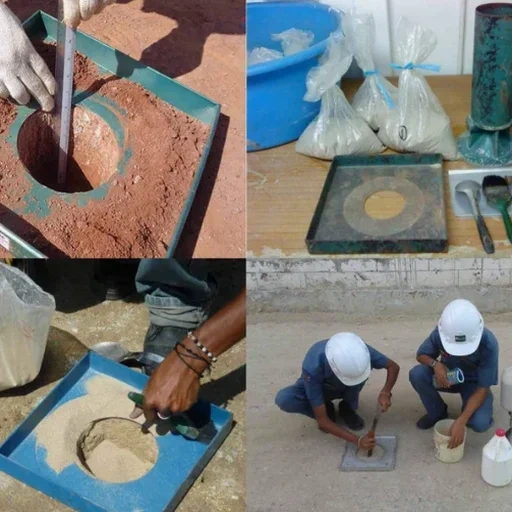
In-situ testing in Des Moines provides direct assessment of subsurface conditions without sample disturbance, essential for understanding the behavior of local glacial till, alluvial deposits, and loess-derived soils. These methods verify compaction and bearing capacity in real time, aligning with ASTM International standards and local building codes that demand field validation before foundation placement. A common procedure is the field density test (sand cone method), used to confirm proper compaction in structural fill and utility trenches.

Projects requiring this category include commercial developments, roadway subgrades, and residential foundations across the metro area, where variable soil moisture and layering can affect long-term performance. In-situ data directly informs design parameters for shallow footings and pavement sections, reducing reliance on conservative assumptions. Complementary services such as nuclear gauge testing and proof rolling observation further ensure compliance with project specifications and geotechnical recommendations.

Available services

Field density test (sand cone method)

→ View details

Need a geotechnical assessment?

Reply within 24h.

Email: contact@geotechnicalengineering1.org

Typical values

ParameterTypical value
Anchor typeActive (prestressed) and passive (non-stressed)
Applicable standardFHWA-NHI-10-024, AASHTO LRFD Section 11
Design lifePermanent (75+ years) or temporary (< 24 months)
Corrosion protectionClass I (double protection) or Class II per PTI DC35.1
Typical bond length in till15 to 30 ft depending on undrained shear strength
Proof test load133% of design load (per PTI recommendations)
Creep test duration10 to 60 minutes at lock-off load

Other technical services

01

Tied-back wall anchor design

Design of active prestressed anchors for soldier pile and lagging walls, secant pile walls, and diaphragm walls. Includes bond length calculations, tendon selection, and staged testing specifications for Des Moines glacial till conditions.

02

Passive anchor and soil nail design

Passive ground anchors and soil nail arrays for permanent slope stabilization and temporary excavation support. Grout-to-ground bond stress verified through field pull-out tests, with corrosion protection tailored to project design life.

Applicable standards

FHWA-NHI-10-024: Soil Nail Walls, FHWA-NHI-10-025: Ground Anchors and Anchored Systems, AASHTO LRFD Bridge Design Specs, Section 11, PTI DC35.1: Recommendations for Prestressed Rock and Soil Anchors, ASCE 7-22: Minimum Design Loads for Buildings

Questions and answers

What anchor type works best in Des Moines glacial till?

Prestressed active anchors generally perform better in stiff, overconsolidated till because they limit initial movement and allow verification of capacity through proof testing. Passive anchors can work for temporary applications but require careful evaluation of creep potential when the till is saturated. The bond zone should be positioned in the till unit below any surficial sand or fill layers.

How much does anchor design cost for a site in Des Moines?
What testing is required for anchors in central Iowa?

ASTM A416 specifies tendon requirements. On site, we require proof tests at 133% of design load and creep tests lasting 10 to 60 minutes at lock-off load. For critical permanent anchors, extended creep testing and lift-off checks after lock-off are standard practice to confirm long-term performance in Iowa's glacial soils.

Can anchors be installed near the Des Moines River?

Yes, but groundwater is the controlling factor. Alluvial sands near the river are permeable and can cause grout loss during installation. We design for fully grouted bond zones using tremie methods and specify watertight corrosion protection. Anchor free lengths are extended to place the bond zone in competent till or shale below the river valley deposits.

Location and service area

We serve projects across Des Moines and surrounding areas.

View larger map