Together, we solve the challenges of tomorrow.
LEARN MORE →In Des Moines, the integrity of slopes and retaining walls is far more than a construction detail—it is a fundamental component of public safety, property protection, and long-term infrastructure resilience. The category of Slopes & Walls encompasses the specialized geotechnical engineering required to analyze, design, and stabilize earthen embankments, natural hillsides, and the vertical or near-vertical structures that retain soil. From the river bluffs that frame the Des Moines River valley to the cut slopes along Interstate 235, these features are constantly subjected to the region's freeze-thaw cycles, seasonal saturation, and urban loading. A comprehensive slope stability analysis is often the first step in understanding how these natural and engineered landforms will perform over time, ensuring that development can proceed without unacceptable risk of landslides, erosion, or wall failure.
The local geology of Des Moines presents a distinct set of challenges that directly influence slope and wall engineering. The area is underlain by a sequence of Pennsylvanian-age sedimentary rocks—predominantly shale, limestone, and sandstone—capped by variable thicknesses of glacial till and loess-derived soils. These surficial soils, particularly the loess, are highly erodible and can lose significant strength when saturated, making them prone to shallow sloughing and deeper rotational failures. The Des Moines Lobe, the most recent glacial advance into the region, left behind a landscape of low rolling hills and buried valleys filled with compressible alluvium. This means that a retaining wall design in the metro area must account not only for the retained earth pressure but also for potential global instability through weak foundation soils, a condition that often necessitates integrating active/passive anchor design to transfer loads into more competent bedrock or dense till at depth.
Regulatory compliance in Des Moines is governed by a combination of local ordinances and statewide codes, most notably the Iowa Statewide Urban Design and Specifications (SUDAS). Chapter 6 of the SUDAS Design Manual provides detailed criteria for geotechnical site investigations, earthwork, and retaining structures, referencing AASHTO LRFD methodologies for structural design. The City of Des Moines further enforces the International Building Code (IBC) with local amendments, which mandates minimum design factors of safety for permanent slopes and walls—typically 1.5 for static conditions and 1.1 for seismic. For any project disturbing more than one acre, the Iowa Department of Natural Resources (DNR) requires a National Pollutant Discharge Elimination System (NPDES) permit, tying erosion control directly to slope stabilization measures. Understanding this layered regulatory framework is essential, as a properly engineered retaining wall design must satisfy both structural safety factors and stormwater management requirements.
The types of projects that demand these operations in Des Moines are exceptionally diverse. Commercial developments along the Jordan Creek corridor frequently require tall, tiered retaining walls to maximize buildable acreage on sloping terrain, often utilizing mechanically stabilized earth (MSE) systems or soldier pile and lagging walls with tieback anchors. Municipal infrastructure projects, such as bridge abutments for the Grand Avenue or Fleur Drive overpasses, rely on robust slope stabilization to protect critical transportation arteries from scour and lateral spreading. Residential subdivisions expanding into the western bluffs necessitate site-specific slope stability evaluations to ensure that cut-and-fill operations do not create long-term maintenance liabilities. Even historic neighborhoods near the river, like Sherman Hill, encounter challenges with aging stone retaining walls where restoration or replacement must be designed to modern standards while respecting aesthetic constraints. In every case, the integration of a thorough slope stability analysis with a context-sensitive structural solution is non-negotiable.
The primary triggers are excessive moisture infiltration from heavy rainfall or snowmelt, which saturates the loess and glacial till soils common to the region, drastically reducing their shear strength. Freeze-thaw cycles further weaken the near-surface soils by creating ice lenses that collapse upon thawing. Additionally, unregulated surface runoff, poor drainage design, and toe erosion along rivers and creeks actively undercut natural slopes, while uncontrolled fill placement or over-steepening during construction introduces destabilizing surcharge loads.
A retaining wall becomes necessary when space constraints prevent a stable, unreinforced slope from being constructed at a safe angle, typically where right-of-way limits, property boundaries, or existing structures prohibit a flatter grade. Walls are also mandated when a near-vertical face is needed to maximize usable land area. The choice between a wall and a reinforced slope hinges on a cost-benefit analysis of excavation volume, structural materials, and long-term maintenance, governed by SUDAS and IBC guidelines.
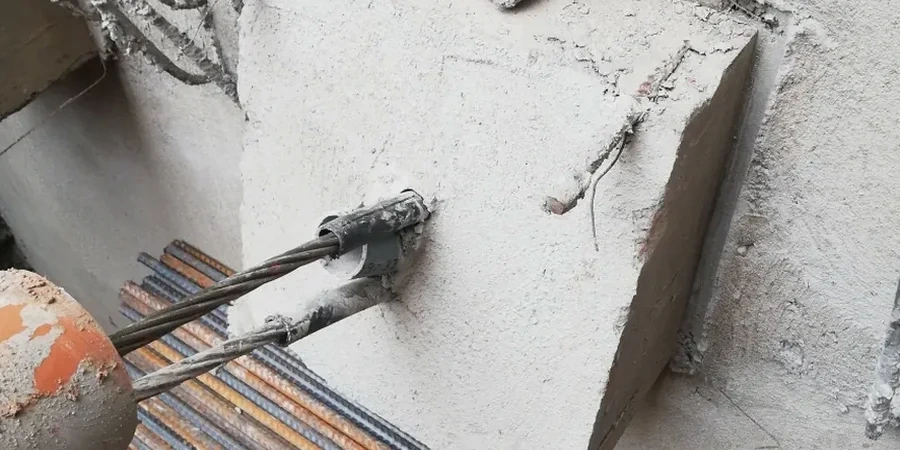
An active anchor system applies a pre-determined tension to the anchor head during installation, immediately loading the tendon and compressing the retained soil mass to minimize future deformation. This is common in tieback walls for deep excavations. A passive anchor, by contrast, is not tensioned during installation; it only develops resistance as the ground moves and loads the tendon, making it suitable for stabilizing existing slopes where movement has already initiated. The selection depends on tolerable displacement limits and the required service life of the structure.
A city building permit is required for any retaining wall over four feet in height, supported by engineered drawings sealed by a licensed Iowa Professional Engineer. If the project disturbs more than one acre, an NPDES General Permit No. 2 from the Iowa DNR is mandatory, requiring a Stormwater Pollution Prevention Plan (SWPPP). Work within a floodplain or near a waterway may also trigger a floodplain development permit from the City of Des Moines and a Section 404 permit from the U.S. Army Corps of Engineers.