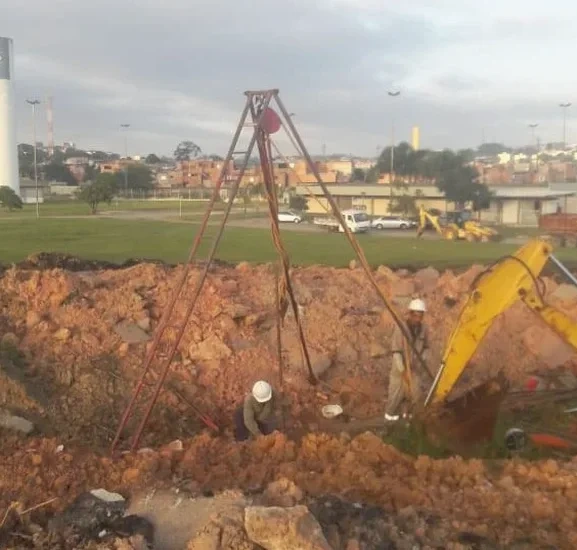
Central Iowa's glacial till and loess-mantled uplands create a specific set of challenges for earthwork contractors in Des Moines. The city sits on a veneer of Wisconsinan-age loess overlying pre-Illinoian glacial deposits, which means fine-grained soils dominate most project sites from the East Village to Jordan Creek. These silts and lean clays can shift from semi-solid to plastic with just a few percentage points of moisture change, a sensitivity that hits hard during the spring thaw and summer storm cycles. Atterberg limits testing provides the quantitative boundary between these states: the liquid limit where the soil begins to flow, the plastic limit where it crumbles, and the plasticity index that ties directly to swell potential and compaction behavior. Our Des Moines laboratory runs these tests under ASTM D4318 protocols, delivering the soil classification data that geotechnical engineers need to specify foundation depth, select borrow material, and anticipate volume change before the first cubic yard is moved. For projects requiring a full mechanical characterization alongside plasticity data, we often pair this with a triaxial shear test when the design calls for strength parameters under drained conditions.
A plasticity index above 15 in Des Moines loess signals a soil that will fight compaction and swell with moisture—knowing the number before you grade saves rework.
How we work
Des Moines grew along the confluence of the Raccoon and Des Moines rivers, and much of its early 20th-century expansion pushed into floodplain deposits and loess-bluff terrain that still defines subsurface conditions today. The city's Unified Soil Classification System (USCS) mapping relies heavily on the Casagrande plasticity chart, where the liquid limit and plasticity index plot determines whether a material is classified as CL, CH, ML, or MH. This is not just academic box-checking: a CL soil in Des Moines with a PI above 15 will likely exhibit moderate to high swell potential, while an ML silt with a liquid limit near 50 may be prone to collapse under load. Our lab technicians use both the Casagrande cup method and the fall-cone alternative, cross-checking results when samples show borderline behavior near the A-line. Data turnaround is typically 48 hours for routine projects, with same-day reporting available for construction-phase verification. We report the full Atterberg suite—liquid limit, plastic limit, plasticity index, and liquidity index when natural moisture content is provided—alongside grain-size distribution from sieve and hydrometer analysis, giving the design team a complete picture of the fine fraction.
Local context
A mixed-use project in the Ingersoll Avenue corridor encountered a lens of fat clay with a liquid limit of 72 and a plasticity index of 41 at subgrade depth, directly beneath a planned slab-on-grade. The initial site investigation had averaged PI values from bulk samples and missed the pocket entirely. With a PI above 35, this soil is classified as highly expansive per the Holtz and Gibbs criteria, and seasonal moisture cycling under a conditioned slab would have generated differential heave exceeding 2 inches over a single winter. The fix required overexcavation to 4 feet, import of select fill with PI below 12, and a capillary break layer—all identified because Atterberg testing was repeated at closer spacing after the first anomalous result. In Des Moines, where loess thickness varies from 0 to 60 feet across short distances, skipping detailed plasticity profiling on fine-grained sites courts exactly this kind of risk. The liquidity index adds another layer: a value near or above 1.0 indicates a normally consolidated or sensitive clay that loses strength when remolded, a condition seen in alluvial deposits along the Des Moines River south of downtown.
Reference standards
ASTM D4318-17e1: Standard Test Methods for Liquid Limit, Plastic Limit, and Plasticity Index of Soils, ASTM D2487-17: Standard Practice for Classification of Soils for Engineering Purposes (Unified Soil Classification System), AASHTO T 89-13: Standard Method of Test for Determining the Liquid Limit of Soils, AASHTO T 90-16: Standard Method of Test for Determining the Plastic Limit and Plasticity Index of Soils
Questions and answers
What Atterberg limits test methods does your Des Moines lab use?
We run ASTM D4318 using the Casagrande cup (multipoint method) for liquid limit and the hand-rolling method for plastic limit. For samples where the cup method gives borderline results near the A-line, we cross-check with the fall-cone method. All testing is performed on material passing the No. 40 (425 μm) sieve, with moisture content determined by oven drying at 110 °C per ASTM D2216.
How much soil sample do I need to send for Atterberg testing?
We require approximately 200 grams of dry material passing the No. 40 sieve for a complete Atterberg limits suite. If you are shipping a bulk sample from a Des Moines project site, send 500 grams of representative fine-grained soil and we will process it through the sieve in our lab. Samples should be sealed in airtight containers to preserve natural moisture if the liquidity index is also required.
What does Atterberg limits testing cost in the Des Moines area?
How do you classify expansive soils using Atterberg limits data?
We apply the Holtz and Gibbs (1956) expansion potential classification based on plasticity index: PI below 15 is low expansion, 15-25 is medium, 25-35 is high, and above 35 is very high. For Des Moines loess and glacial till, PI values commonly fall in the 12-28 range, indicating moderate to high swell potential. We also report the USCS group symbol and note the soil position relative to the A-line on the Casagrande plasticity chart.