← Home · Laboratory

Laboratory CBR Testing in Des Moines: Pavement Design Based on Local Soils

Together, we solve the challenges of tomorrow.

LEARN MORE →

Des Moines grew where the Raccoon and Des Moines rivers meet, and that river-bottom geography left behind a patchwork of alluvial silts and lean clays that still shape every road project today. A test pits program almost always turns up variable moisture and organic lenses within the first five feet—conditions that make pavement subgrade evaluation non-negotiable. The laboratory CBR test, run under ASTM D1883 on remolded or undisturbed samples, gives Iowa DOT and city reviewers the soaked bearing value they need to approve structural sections. Our Des Moines lab sees soils from the glacial advance limits, meaning one sample can be sandy Wisconsin till and the next pure loess: same metro, completely different CBR curves. We run the three-point compaction family to tie density to strength before the first load ever hits the pavement.

A soaked CBR value on Des Moines loess can drop by half from its unsoaked number. That gap is the real cost driver in pavement thickness.

How we work

Des Moines sits at roughly 850 feet above sea level with a population closing in on 700,000 across the metro—growth that keeps pavement design teams busy on everything from suburban collectors to full-depth reclamation on Fleur Drive. The lab CBR procedure we follow isn’t a single-number exercise; we soak the specimen for 96 hours to simulate the saturated subgrade season that hits central Iowa every spring thaw. For flexible pavement design, the 0.1-inch and 0.2-inch penetration values are read directly from the load-penetration curve and compared against the standard crushed-stone reference. Many Des Moines projects combine our lab CBR with a field sand cone density check to confirm compaction on the same borrow source, and when the soil is borderline plastic we run Atterberg limits to flag volume-change potential that soaking alone won’t reveal. The result is a pavement section that doesn’t just meet AASHTO 93—it fits the exact moisture-sensitivity profile of the site.
Laboratory CBR Testing in Des Moines: Pavement Design Based on Local Soils
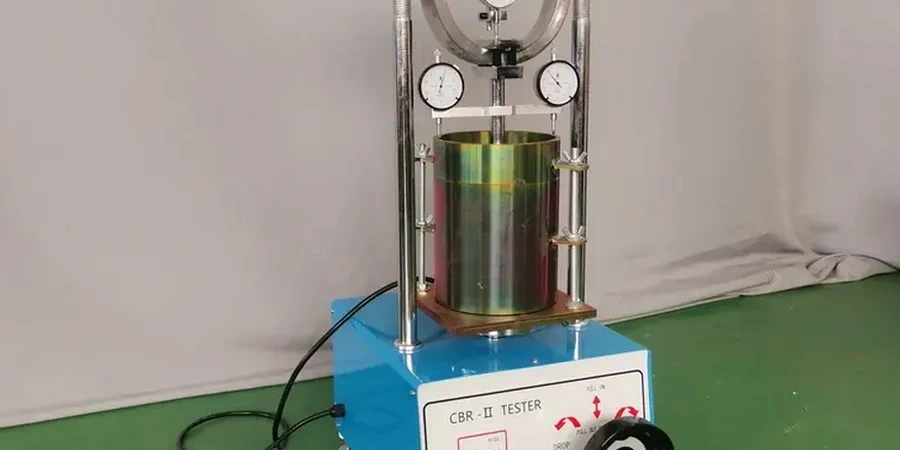
Technical reference image — Des Moines

Local considerations

In Des Moines, we often see CBR values misinterpreted when the sample was compacted at energy that the field roller cannot reproduce—especially on silty-clay subgrades where Modified Proctor effort masks the true weak-season behavior. A spec that calls for 6-inch aggregate base over a CBR-6 subgrade can look safe on paper and still rut within two winters if the soaked value wasn’t conservative enough. The bigger risk shows up on commercial pad sites where the pavement abuts a loading dock: differential movement between the building foundation and the pavement edge is almost always traced back to subgrade CBR assumptions that ignored seasonal saturation. Our lab flags low-soak CBR results early and recommends either a thicker base course, chemical stabilization with lime or fly ash, or a flexible pavement design analysis that layers the actual modulus values rather than a generic structural number.

Need a geotechnical assessment?

Reply within 24h.

Email: contact@geotechnicalengineering1.org

Typical values

ParameterTypical value
Standard followedASTM D1883 / AASHTO T-193
Specimen preparationRemolded at optimum moisture per ASTM D698 or D1557
Soaking period96 hours submerged (saturated condition)
Surcharge weightEquivalent to anticipated pavement weight
Penetration readings0.025 in to 0.500 in; reported at 0.1 in and 0.2 in
Compaction energyStandard (12,400 ft-lbf/ft³) or Modified (56,000 ft-lbf/ft³)
Swelling measurementDial gauge during soak; % swell reported

Other technical services

01

Soaked Laboratory CBR with Compaction Curve Family

Three-point Proctor (standard or modified) plus a 96-hour soaked CBR test on the same material. We report dry density vs. moisture, CBR at each compaction point, percent swell, and the load-penetration curve corrected for seating error. Turnaround is typically five business days; rush processing available for change-order disputes.

02

CBR-Based Pavement Thickness Verification Package

For projects already designed to a target CBR, we test the actual subgrade or borrow source and compare the soaked result against the design assumption. The report includes AASHTO 93 structural-number back-calculation and a side-by-side table showing whether the planned section still works—or needs a subbase adjustment.

Applicable standards

ASTM D1883-21, AASHTO T-193-22, Iowa DOT Standard Specifications (Section 2112), ASTM D698 / D1557 (moisture-density reference)

Questions and answers

When is a soaked CBR required instead of an unsoaked test?

Iowa DOT and most Des Moines municipal standards require a soaked CBR (96 hours submerged) for all pavement subgrade evaluation because Iowa soils experience prolonged saturation during spring thaw and wet fall seasons. The soaked value represents the weakest condition the subgrade will see in service, and pavement thickness must be designed for that minimum strength, not the dry-summer number.

What does a laboratory CBR test cost in Des Moines?
How many CBR specimens do I need for a parking lot versus a collector street?

For a parking lot or light-duty access road, two representative bulk samples from the upper 18 inches of subgrade are usually sufficient—one from the cut section and one from fill. A collector street or arterial in Des Moines should have at least one CBR test per 500 linear feet per soil type encountered, with separate samples from any area where the subgrade changes from silt to clay or where organic material was stripped.

Can the lab CBR result be used directly in the AASHTO 93 pavement design equation?

Yes, the soaked CBR value at 0.1-inch penetration is the direct input for the AASHTO 93 flexible pavement structural-number equation when using the Iowa DOT regional calibration. Our reports provide both the raw CBR and the calculated resilient modulus (Mr ≈ 1500 × CBR for fine-grained soils) so the designer can use either the empirical or mechanistic-empirical approach without recalculating.
Location and service area

We serve projects across Des Moines and surrounding areas.

View larger map