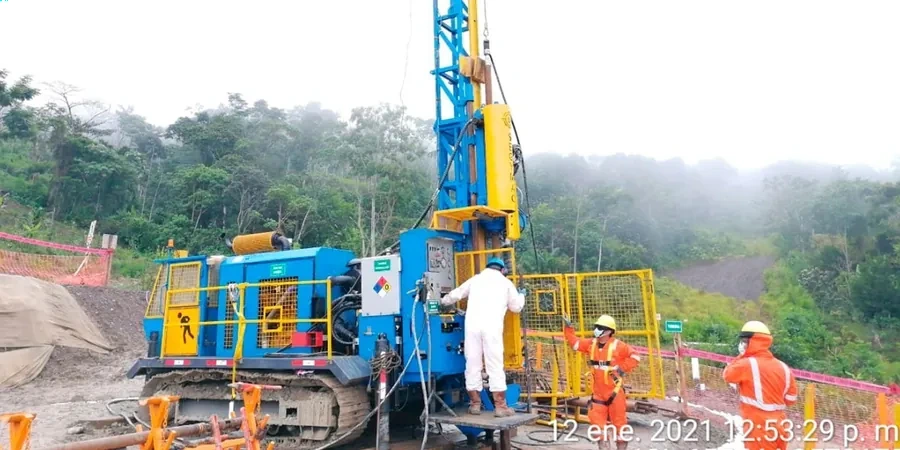
The CME-75 truck-mounted drill rig sits on a residential lot near Gray's Lake, and within minutes the automatic safety hammer starts its 30-inch drop cycle. In Des Moines, where glacial till and weathered shale sit beneath a blanket of loess, the standard penetration test remains the most practical tool we have for profiling subsurface strength. Our crews run split-spoon samplers through stiff clay layers that can push blow counts past 40 with little warning, and the jarring rhythm of the hammer tells an experienced driller more than a spreadsheet ever could. We log each 6-inch increment separately on the ASTM D1586 field sheet, noting the color change from tan loess to gray till the moment it appears. For projects near the Raccoon River floodplain, where groundwater sits within 8 feet of grade, we also pair SPT data with a CPT investigation to capture the transition from soft alluvium to competent bearing strata without gaps in the profile.
A 48-inch frost depth and N-values that can jump from 12 to refusal in 18 inches — Des Moines soils don't reward guesswork.
How we work
A mistake we see repeatedly in central Iowa is contractors accepting SPT blow counts from uncorrected hammers and then wondering why their spread footings settle differentially within two winters. The freeze-thaw cycle in Des Moines — where the frost depth reaches 48 inches per the local building code — exacerbates any error in N-value interpretation. We run only auto-trip hammers with a calibrated energy ratio of 60%, recording the rod length, sampler type, and borehole diameter for every test so the N60 correction is traceable. In clayey loess over weathered shale, the N-value often jumps from 12 to refusal in less than 18 inches; without a proper refusal criterion logged, the designer assumes a gradual transition that does not exist. Our field logs flag refusal at 50 blows over 6 inches, and we retrieve Shelby tubes from the adjacent borehole when the SPT indicates a stiff cohesive layer that warrants triaxial testing.
Questions and answers
What is the typical cost range for an SPT borehole in the Des Moines area?
How does the SPT N-value relate to footing design in Iowa's frost zone?
The N-value is used to estimate the allowable bearing pressure, but in Des Moines the frost depth of 48 inches means the footing must bear below that elevation regardless of the blow count. We carry out N60-corrected values at the proposed bearing depth so the structural engineer can check both bearing capacity and settlement under the IBC-prescribed load combinations.
Can SPT results be used to estimate shear-wave velocity for a seismic site class in Des Moines?
Yes, the SPT N-values are one of the ASCE 7-22 accepted methods for estimating Vs30 and assigning a Site Class. In central Iowa's loess-over-till profile, we apply published correlations that account for soil type and depth, and we flag any borderline cases where a direct MASW survey would refine the site classification.
How many SPT boreholes does a typical commercial building in Des Moines require?
The IBC requires a minimum of one borehole for every 2,500 square feet of building footprint for structures on unknown fill, but for the glacial soils in Des Moines, the geotechnical engineer typically specifies a grid of three to five SPT boreholes to capture the variability in the loess thickness and till density across the site.