← Home · Foundations

Shallow Foundation Design in Des Moines: Bearing Capacity and Settlement Analysis

Together, we solve the challenges of tomorrow.

LEARN MORE →

A three-story office building near the Des Moines River floodplain showed us exactly how much bearing capacity can shift across a single project site. The geotechnical investigation revealed layered alluvial silts over glacial till at varying depths, a profile that’s common across much of Polk County but demands careful interpretation when designing spread footings. We have seen developers assume uniform soil conditions in downtown Des Moines only to encounter compressible lenses that drive differential settlement well beyond tolerable limits. Integrating in-situ permeability data early in the exploration phase helps refine the drainage assumptions that govern long-term performance under cyclic loading. For shallow foundations in Des Moines, the critical path runs through three interdependent checks: ultimate bearing capacity against shear failure, total and differential settlement over the design life, and frost protection depth mandated at 48 inches below finished grade per local amendments to the IBC.

In Des Moines, a one-foot variation in footing embedment can shift allowable bearing pressure by 30 percent when you cross from glacial till into alluvial terrace deposits.

How we work

The contrast between the East Village redevelopment zone and the suburban expansions west of I-35 illustrates why Des Moines demands site-specific shallow foundation parameters. East Village sits on older glacial deposits with higher relative density and N60 values frequently exceeding 15 blows per foot in the bearing stratum, which often allows net allowable bearing pressures in the range of 2,500 to 3,500 psf for strip footings. Move five miles west toward West Des Moines and you encounter loess-derived silts with collapse potential upon wetting, a condition we address through moisture-controlled compaction verification and proctor tests that establish the reference density for engineered fill beneath footings. The design workflow we apply across Des Moines projects follows a consistent logic: classify the soil per ASTM D2487, correlate strength parameters from SPT N-values corrected for overburden and energy ratio, compute bearing capacity using the general shear equation with Vesic’s bearing capacity factors, and then run immediate and consolidation settlement analyses through Schmertmann or Janbu methods depending on whether the stratum behaves as cohesionless or cohesive material. Groundwater elevation matters here more than many contractors realize, particularly in spring when the Raccoon and Des Moines Rivers run high and the water table rises to within five feet of grade in low-lying areas.
Shallow Foundation Design in Des Moines: Bearing Capacity and Settlement Analysis
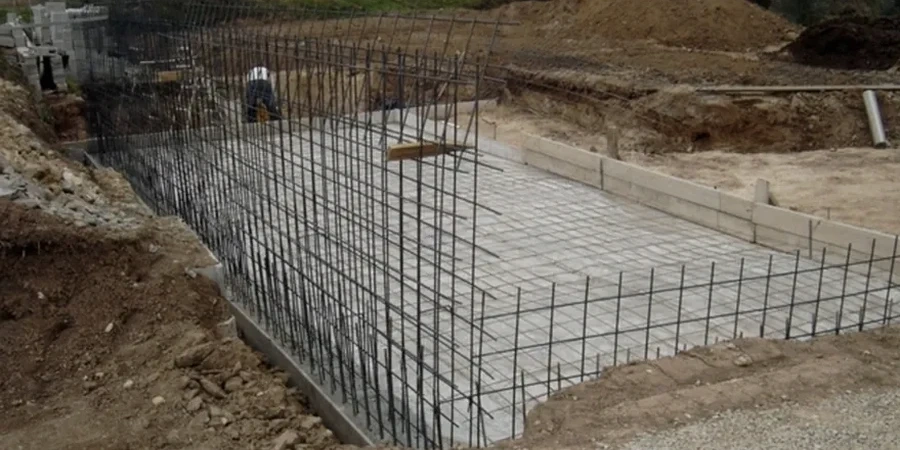
Technical reference image — Des Moines

Local considerations

The most frequent mistake we encounter in Des Moines is a contractor pouring strip footings directly on undisturbed loess without a mud mat or compaction lift, assuming the natural soil stiffness is sufficient. Loess in Iowa weathers quickly when exposed to construction traffic and rainfall, developing a softened zone that loses 40 to 60 percent of its original bearing modulus within a few days of excavation. Once that softened layer gets trapped beneath a footing, differential settlement manifests within the first two years of service, cracking partition walls and racking door frames in ways that are expensive to remediate. Another pattern we see involves underestimating the influence of mature deciduous trees near the building footprint: clay desiccation driven by root systems in summer creates shrinkage cracks that propagate below footing level and reduce lateral confinement. A solid shallow foundation design for Des Moines sites includes a pre-pour inspection of the bearing surface, verification that soil type and consistency match the geotechnical report assumptions, and a contingency for undercut and replacement with compacted granular fill where organic silt or disturbed material is encountered at the design bearing elevation.

Need a geotechnical assessment?

Reply within 24h.

Email: contact@geotechnicalengineering1.org

Typical values

ParameterTypical value
Minimum footing embedment depth48 inches (frost depth per IBC, Des Moines amendment)
Typical net allowable bearing pressure1,500 – 3,500 psf (cohesive glacial till)
Maximum tolerable total settlement1.0 inch (conventional structures per ASCE 7 criteria)
Maximum tolerable differential settlement0.5 inch over 30-ft span (Type B construction)
Minimum factor of safety (bearing)3.0 (dead load plus live load condition)
Groundwater adjustment factor0.5 applied to effective overburden term when GWT < B below base
Load combination for sizingASCE 7 Strength Design Load Combinations (IBC Section 1605.2)
Minimum footing reinforcement cover3 inches cast against earth (ACI 318, exposure class F1)
Subgrade preparation standardProof-rolled and density-tested to 95% of modified Proctor maximum

Other technical services

01

Bearing capacity and settlement analysis

We compute allowable bearing pressures using general and local shear failure models, then run immediate and consolidation settlement calculations through Schmertmann and Janbu methods. The output is a footing schedule with dimensions, embedment depths, and estimated settlement values for each column and wall line.

02

Frost-protected shallow foundation design

Des Moines code requires minimum 48-inch embedment. We design insulated shallow foundations per ASCE 32 where site constraints prevent deep excavation, verifying that subgrade temperatures remain above freezing under design winter conditions for central Iowa.

03

Subgrade improvement and fill specification

Where loess collapse potential or soft alluvial clays control the design, we specify undercut depth, engineered fill material gradation, moisture conditioning ranges, and compaction acceptance criteria tied to modified Proctor density testing.

Applicable standards

IBC (2021 edition, with City of Des Moines local amendments for frost depth and groundwater), ASCE 7-22 Minimum Design Loads and Associated Criteria for Buildings and Other Structures, ASTM D1586 Standard Test Method for Standard Penetration Test (SPT) and Split-Barrel Sampling of Soils, ASTM D2487 Standard Practice for Classification of Soils for Engineering Purposes (Unified Soil Classification System), ACI 318-19 Building Code Requirements for Structural Concrete (footing design and reinforcement detailing)
Questions and answers

What is the typical cost range for a shallow foundation geotechnical design in Des Moines?
How deep do footings need to be in Des Moines to meet frost protection requirements?

The City of Des Moines enforces a minimum footing depth of 48 inches below finished exterior grade for frost protection, following the IBC with local climate amendments. In practice, we often specify 48 to 54 inches to provide margin against unusually cold winters and to seat the footing below the zone of seasonal moisture fluctuation that affects volume-change-prone soils.

What soil conditions in Des Moines most commonly control shallow foundation design?

Two conditions dominate: compressible alluvial silts and clays in the Des Moines River valley that govern settlement calculations, and loess-derived silts on the upland terraces west of downtown that exhibit collapse potential upon wetting. In both cases, the allowable bearing pressure is often limited by settlement criteria rather than shear strength, so the design focuses on keeping total and differential movements within tolerable limits.

Location and service area

We serve projects across Des Moines and surrounding areas.

View larger map