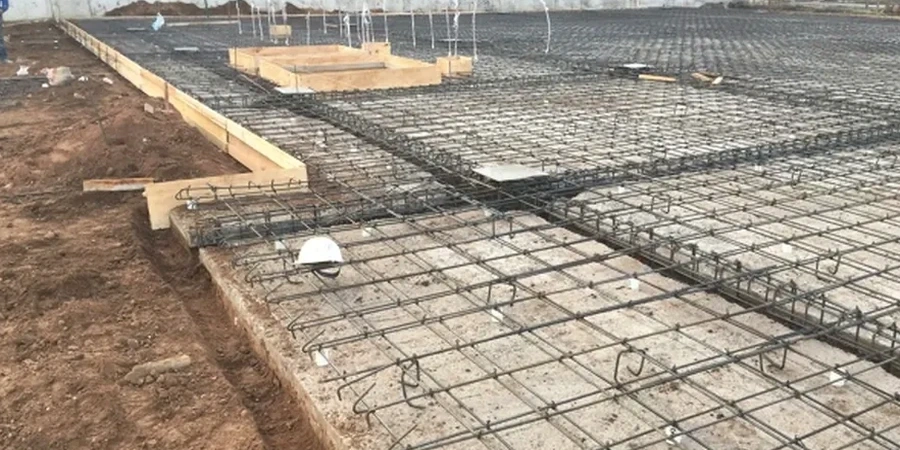
Des Moines sits on a tricky mix of glacial till and loess-derived fat clays that swell with the seasons. The upper 10 to 15 feet across much of Polk County are lean to fat clay overlying weathered shale, and the water table routinely rises within 6 feet of grade during spring. That combination makes differential settlement the number one concern for any mid-rise or heavy commercial structure. A properly designed raft foundation distributes column loads across a continuous mat, reducing the contact pressure and bridging soft spots without the cost of deep piling. We run the CPT testing you need to map compressible lenses before sizing the mat, and our laboratory program follows ASTM D2487 for classification plus D2435 consolidation curves to feed into the settlement model. Whether you are building along the Raccoon River floodplain or in the East Village redevelopment zone, the mat thickness and reinforcement layout have to reflect the real soil profile, not a textbook assumption.
A raft mat on Des Moines fat clay is less about bearing failure and entirely about controlling differential movement across the slab footprint.
Questions and answers
What is the typical cost range for a raft foundation geotechnical package in Des Moines?
How deep does a raft mat need to be in Des Moines to avoid frost heave?
Per IBC Table 1809.5, the frost depth in Des Moines is 48 inches. The bottom of the mat must be at or below that elevation unless the building is continuously heated and the perimeter is insulated, which we evaluate case by case for unheated parking levels.
Can a raft foundation work on the fat clays common around downtown Des Moines?
Yes, and it is often the preferred solution. The key is characterizing the swell potential through Atterberg limits and consolidation-swell tests, then sizing the mat to apply enough dead load to counteract heave pressure. We also specify a moisture-conditioned subgrade and perimeter drainage to keep the clay moisture content stable.
What happens if you find soft lenses under the proposed mat footprint?
We map the lenses with CPT soundings and run consolidation tests on undisturbed samples. If the settlement exceeds the structural tolerance, we evaluate ground improvement options such as stone columns or rigid inclusions to stiffen the compressible zone before placing the mat.
Do you handle the structural reinforcement design or just the geotechnical parameters?
We carry out the subgrade reaction modulus, allowable bearing pressure, and settlement predictions. Our structural team then designs the mat reinforcement, thickness, and punching shear reinforcement per ACI 318. We coordinate directly with the structural engineer of record to ensure the geotechnical model is correctly implemented.